Speedrunning judgement
I hate to be a “Harvard Business School is the answer to all our problems” guy, but apparently today I’m going to go there.
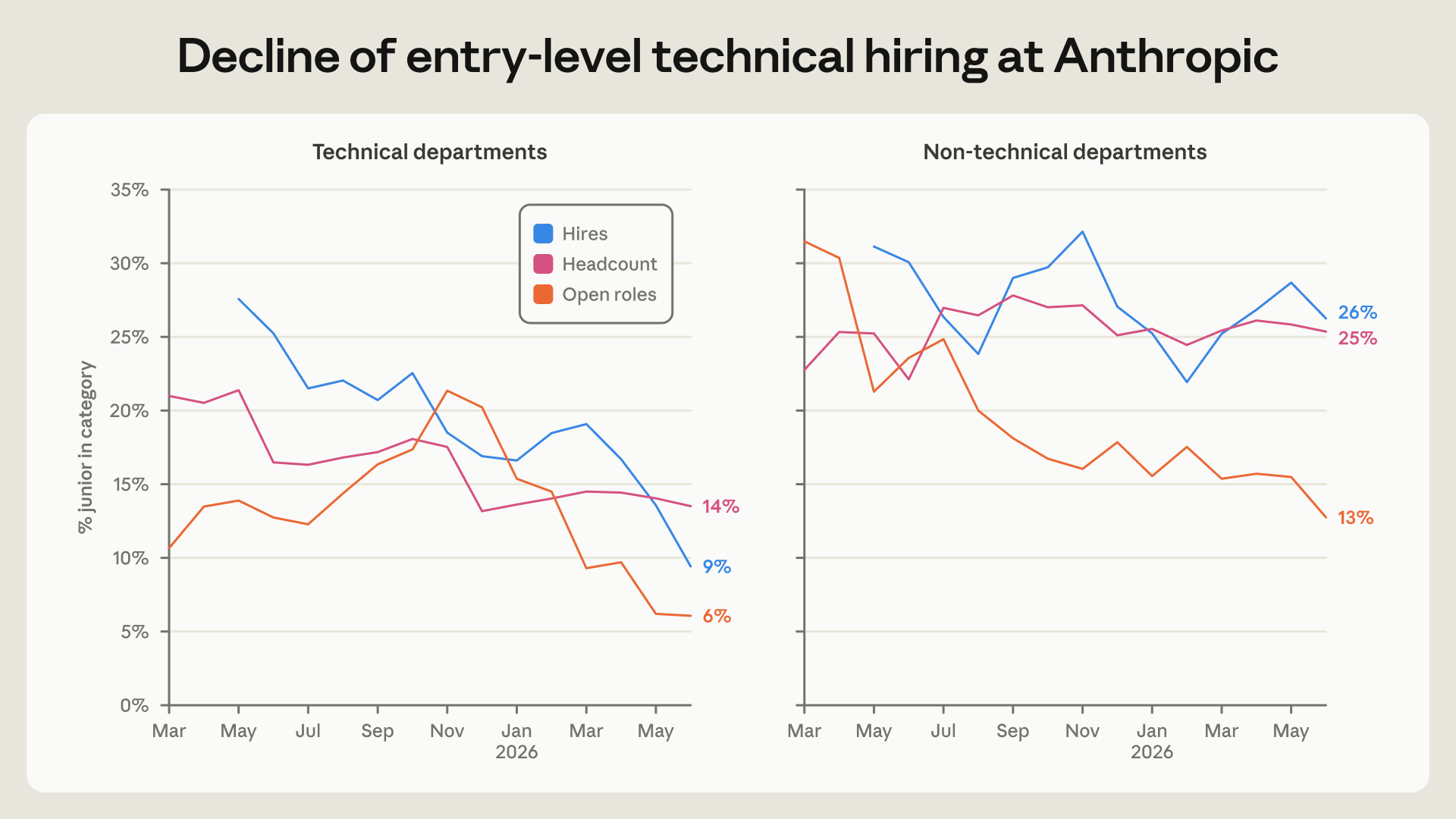
Anthropic recently put out numbers on its own hiring, and junior roles have dropped from 27% of its technical hires to 9% since early 2025. There just isn’t as much need for entry-level people anymore.
You don’t hire a new grad because they’ll speed you up (they’ll probably slow you down, tbh). You hire them because the mistake-laden grunt work teaches them the judgment and intuition they need to become productive senior members of the team. A new grad is an investment that pays off three or four years out.
Agents are absorbing that work, and they’ll keep absorbing more of it. They do it cheaper, faster, and better than any new grad can.
If that’s true, where do our mid-level people come from in a few years? Our senior people in ten? And if you’re a student or a new grad today, what are you supposed to do?
It feels trite to say it, but Harvard may have the answer.
HBS teaches almost entirely through cases, which are real business situations written up as what-ifs. Students get the case, form an opinion, and then defend it in a room full of people who disagree with them, vigorously. There are no “right” answers, just judgment calls. And blitzing through hundreds of them sharpens your decision-making and pattern recognition skills as fast as possible. It compresses the cruxes of hundreds of business lifetimes into a two-year program.
Companies hire HBS grads for their raw intelligence, the prestige, and any number of other reasons. But they also hire them because the case method is probably the most proven technique we have for speedrunning judgment.
But this technique isn’t limited to HBS students. Pilots drill with the flight data from past disasters, and race car drivers train at speed on sim rigs. Even design students eviscerate each other’s work daily in critiques. Basically anyone who can find a way learns this way, because it’s the best way we’ve found. The raw ingredients are:
- →Realistic simulations
- →An accelerated pace
- →Tight feedback loops
You don’t need an Ivy League pedigree to use that recipe. Learn about your industry, read old news, try to put yourself in that leader’s shoes, and propose a solution. Do it alone, do it with people who will argue with you, or hell — talk through it with AI. (Ironically, AI is great at building cases from past events. It can’t tell you if you’re “right”, but then again, neither can a human.)
There’s no way you’re going to out-compute, out-research, or out-work an AI model. But working more was never what made experienced hires valuable in the first place.
The only defensible asset is judgment in ambiguity, and that’s the thing the case method teaches best.